Standing Was Never the Issue
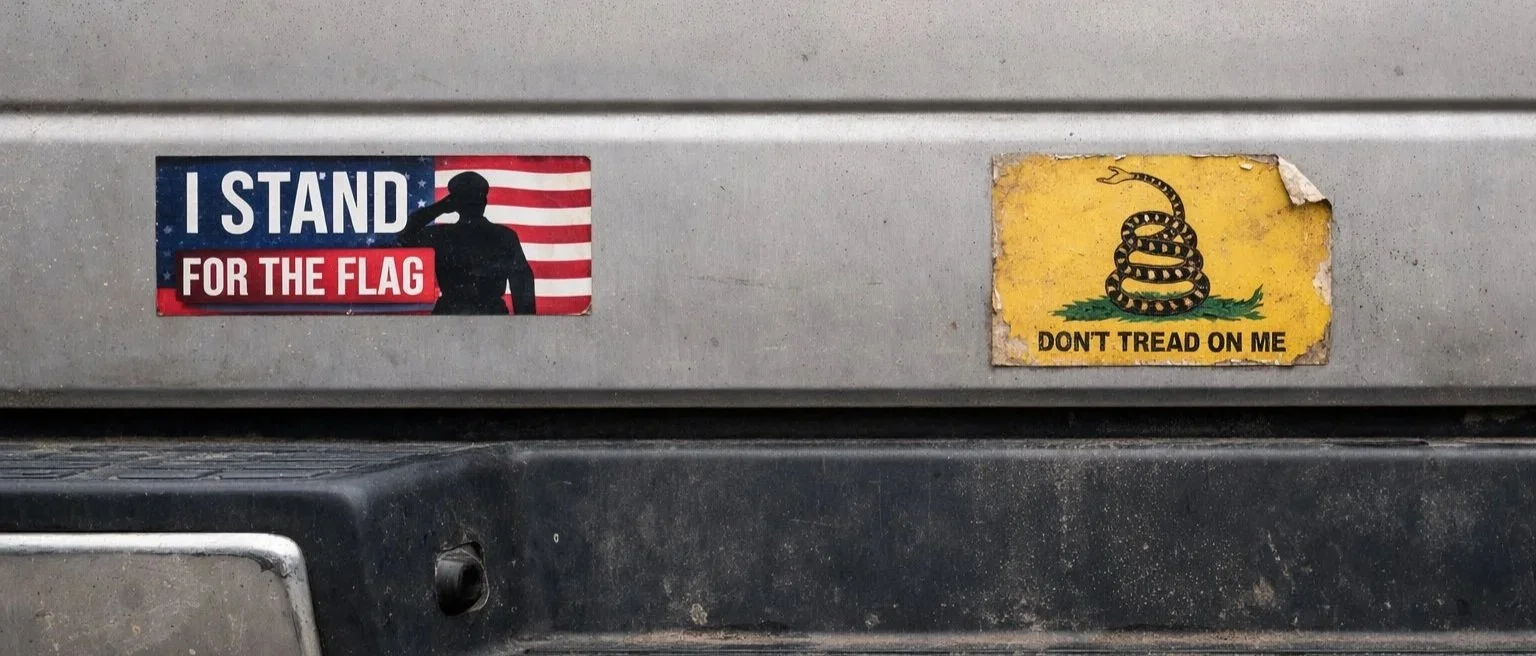
Parallel Warnings in Plain Sight
I was offered an “I Stand for the Flag” bumper sticker once.
My father-in-law meant it kindly. It wasn’t a challenge or a provocation. Just an offer. A shared symbol. A small adhesive declaration of values.
I declined.
Not because I don’t stand for the flag. I do. I stand for it in stadiums and gymnasiums and dusty fields where kids fidget and hands go to hearts a half beat late. I stand without irony.
I declined because I understood that the sticker wasn’t actually about standing.
It was about ending the conversation.
When Colin Kaepernick knelt, the country didn’t argue with what he said. It argued with how he said it. The message itself barely made it to the table. Police violence. Unequal protection. Whose lives are treated as disposable.
Instead, the spotlight swung to posture. To decorum. To the flag. To the troops.
A masterful deflection, whether intentional or not. A way to ignore the message while feeling morally upright. A way to say, “I don’t have to hear you, because I’ve found something about you to be offended by.”
And for a long time, that worked.
Now I hear people saying, “This is not who we are.”
I understand the impulse. It sounds like grief. It sounds like disbelief. It sounds like a country staring at its reflection and trying to look away.
But Howard Zinn sits quietly behind that sentence, reminding us that history is not a mood. It’s a record. And by that record, this is not unfamiliar at all.
This is exactly who we have been.
What feels new is not the behavior. It’s the proximity.
For Black Americans, none of this is unrecognizable. The gap between official statements and lived reality. The insistence that video is misleading. The request for patience. The demand for trust from institutions that have not earned it.
They have been saying this for generations.
The difference now is that some white Americans are being forced to see it without the buffer of abstraction. Without distance. Without the comfort of believing it only happens to someone else.
When two white people are killed by police or federal agents, something shifts. Suddenly the slippery slope doesn’t sound theoretical. Suddenly the warnings feel personal.
The slippery slope people I’m talking about are familiar here in North Idaho. Rural. Armed. Anti lockdown. Anti mandate. Deeply suspicious of government during the COVID years. Gadsden flags. Homemade signs. A belief that something dark was coming, even if they couldn’t quite name it.
And here’s the uncomfortable truth for me.
They were right.
Just not about what.
They feared government overreach. They warned about unchecked power. They talked about tyranny in the abstract. But they aimed their fear sideways instead of upward. Immigrants. Protesters. Cities. “Those people.”
They missed the oldest rule of power.
Systems built without accountability eventually turn on everyone. Not equally. Not at the same time. But inevitably.
Black Americans weren’t predicting that as a threat. They were stating it as physics.
This wasn’t a sudden fall. It was a long descent that some people were always closer to the bottom of.
So when people are saying now, “This isn’t who we are,” what I hear underneath is something else.
This is the first time it’s touching me.
Trump complicates this, but he doesn’t invent it. He doesn’t seem to understand the old choreography. The quiet approvals. The careful language. The slow erosion wrapped in civics vocabulary.
Other presidents knew how to get the sign off. How to let agencies do the damage while sounding reasonable. How to maintain the story even as the record kept growing heavier.
Trump says the thing out loud. He skips the ceremony. He exposes the machinery by not bothering to hide it.
For some, that feels like rupture. For others, it feels familiar.
The system didn’t change. The lighting did.
And somewhere in all of this, Jesus is still standing where he always stood, asking a question that makes everyone uncomfortable.
“Truly I tell you, whatever you did for one of the least of these brothers and sisters of mine, you did for me.”
Not what you stood for.
Not what symbol you defended.
Not what slogan you put on your truck.
What you did for the least protected when it mattered.
That’s why I declined the bumper sticker.
Because standing was never the issue. Listening was.
If we had listened then, really listened, not to tone or posture or symbols but to the message underneath, maybe we wouldn’t be here. Maybe the warning wouldn’t feel so sudden now.
This has always been here.
The only thing that’s changed is who can no longer look away.