THE NIGHT MY MUSICAL ARROGANCE WAS HUMBLED AGAIN
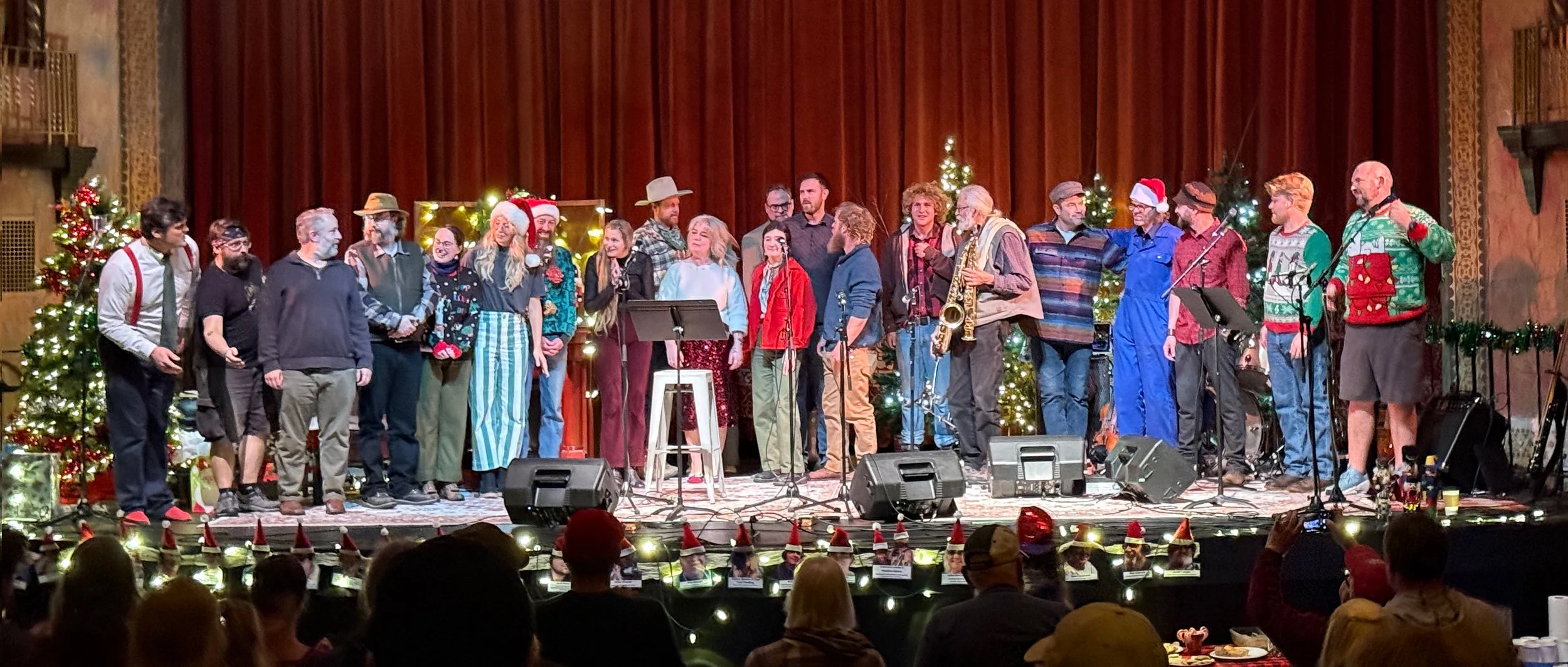
2025 KRFY Radio’s Holiday Spectacular
A Sandpoint Reflection
There are humblings that hurt
and humblings that heal.
Friday night at the Panida was the second kind.
KRFY Radio’s Holiday Spectacular was meant to be lighthearted;
local musicians, a house band, holiday songs.
But something in me shifted again,
the same way it had years earlier at The Longshot,
on that Middle Fork trip,
and the first time I heard Little Wolf sing about coming home.
It happened the moment Kjetil Lund walked onstage.
He stepped into the lights barefoot, pants rolled up like Huck Finn,
a blond afro exploding around his head,
buffalo flannel hanging off him like a folk hero who wandered in from some parallel North Idaho universe.
He looked like he had no business onstage.
He also looked exactly right for it.
Then he opened his mouth,
said “this is the stupidest song I’ve written,”
and proceeded to deliver a set so sharp, so funny, and so quietly brilliant
that I felt my old unearned musical arrogance shrink in my chest.
This town.
This town.
It just keeps doing this to me.
THE FOLK SINGER WITH NO INTERNET RECORD
When I got home, I looked him up.
Nothing.
Just scraps.
Instagram videos of half-sung, half-laughed melodies with voice cracks and rough edges.
No EP.
No website.
No over-polished persona.
And yet;
I could hear it.
Under those last two songs was the beginning of a true folk voice.
The kind that doesn’t show up because of ambition or training playlists.
The kind that emerges like a natural resource.
You don’t teach that.
You don’t engineer it.
You don’t optimize it.
You witness it.
And witnessing it humbled me in the best way.
THE RED ROCKS REALIZATION
Somewhere between his set and the house band’s finale,
I felt something almost embarrassing wash over me:
Not everyone who picks up a guitar dreams of Red Rocks.
Not everyone wants Madison Square Garden.
Some people just want
to play.
Some kids grow up playing soccer without trying to be Pelé.
Some writers never want to publish.
Some painters never want a gallery.
Some musicians never want a tour bus, or a rider, or a billboard in Nashville.
Some people just love the thing.
And that idea, simple as it is, unraveled something important inside me.
Because I grew up in Boulder.
Then Boston.
Then the music-industry idea of “success,”
where ambition and legitimacy were braided so tightly
you couldn’t separate one from the other.
But in Sandpoint, again and again,
I’m reminded:
Art doesn’t need ambition to matter.
Music doesn’t need fame to be real.
Talent doesn’t need a dream to be valid.
Sometimes a barefoot kid singing about Santa being from Clark Fork
is the whole point.
It wasn’t a downgrade in my worldview.
It was an upgrade.
A liberation.
THE HOUSE BAND AND UNREHEARSED MASTERY
The other revelation of the night came from the house band.
They hadn’t practiced with most of the performers.
They were improvising, adapting, listening in real time.
To most of the room, it just sounded good.
To me, it was a masterclass.
I watched musicians communicate through nods, eyebrow movements, micro-pauses.
I watched a drummer jump the gun into a build
and the band leader catch him,
holding him back with nothing but a glance and a subtle shift.
I watched musicians align without speaking.
This is musicianship you can’t fake
and you can’t teach in a Berklee classroom.
It’s lived.
Felt.
Embodied.
And it was happening in a small-town theater on a quiet December night,
played by people who had already worked day jobs
and would go back to them the next morning.
It was pure.
Unpretentious.
Precise.
Alive.
And I loved it.
THE PERMISSION TO SUCK
Walking out of the Panida,
I felt something I hadn’t felt since Boston;
the same feeling I had back when I would walk four blocks from Northeastern to Berklee
just to buy blank staff paper with “Berklee College of Music” printed at the top,
hoping the header might magically transfer talent into my fingers.
Back then, I thought music had to be impressive to matter.
I thought it needed legitimacy.
Technique.
A recording worth showing someone.
A voice that didn’t crack.
A guitar that didn’t clang like my old Yamaha.
And because I didn’t like how I sounded,
I didn’t play.
But that night, watching Kjetil — barefoot, loose, comedic, brilliant, imperfect.
Something loosened inside me.
He made me want to play again.
Not to get good.
Not to perform.
Not to prove anything.
Just to feel something.
He gave me permission:
to suck
to be unpolished
to be messy
to let music be emotional instead of impressive
to play without needing it to sound right
to pick up my guitar for the feeling, not the outcome
There’s a strange freedom in realizing
that the thing you’ve avoided your whole life
because it wasn’t perfect
was never asking to be perfect.
It was asking to be played.
And Friday night, for the first time in a long time,
I walked out wanting to go home,
pick up my guitar,
and let it be exactly what it is:
A wooden box
with six strings
that doesn’t care if I’m any good
as long as I’m honest.
THE DEEPER HUMBLING
The truth underneath all of this is simple:
My musical arrogance isn’t gone.
It’s evolving.
It’s being reshaped by the places and people I love.
Sandpoint keeps showing me
that music is not a ladder
but a room.
Not a destination
but a conversation.
Not a performance
but a practice.
And this town; with its barefoot folk singers,
its house bands improvising miracles,
its snow-dusted theaters,
its quiet geniuses;
keeps humbling me
in the exact ways I need.
Not by making me smaller,
but by making me truer.
Kjetil Lund - Ski Flakes
Kjetil Lund — True Love's Prayer
Brendan Kelty & Katelyn Shook — God Rest Ye Merry Gentlemen/Star Of Wonder