Irony, Sincerity, and the Quiet Work of Becoming
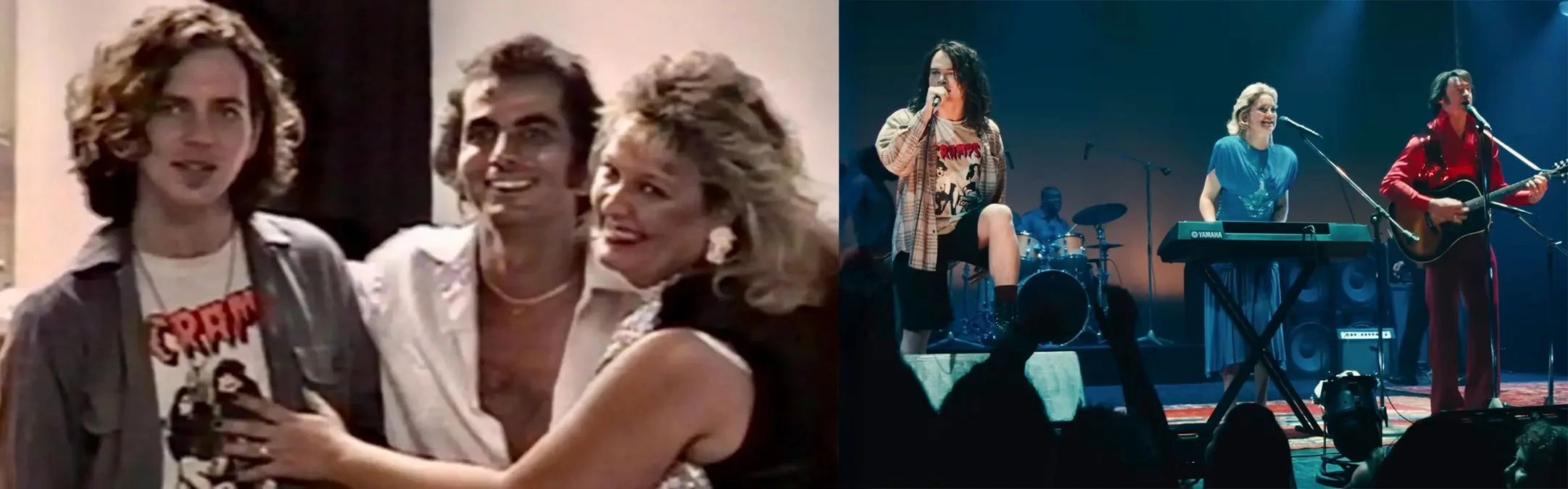
Eddie Vedder with Lightning and Thunder, Milwaukee Summer Fest.(left) Scene from Song Sung Blue(right)
I used to think sincerity and irony lived on opposite sides of a line.
Sincerity felt like childhood. Open windows. Music played too loud. Letting things land without first checking how they might be received.
Irony felt like adulthood. Distance. Taste as armor. Knowing how to belong without revealing too much.
What I understand now is that irony is often sincerity that learned how to survive.
That realization came back to me unexpectedly while watching a movie scene I thought I already understood.
A few days after seeing Song Sung Blue, Pearl Jam posted an old clip from Milwaukee Summerfest. Eddie Vedder onstage with Lightning & Thunder. A moment that, viewed through today’s eyes, feels uncomfortable. A little sharp. A little knowing. The kind of posture that reads less like generosity and more like performance.
It landed differently for me than it once might have.
Not because I wanted Eddie to be perfect.
But because I no longer believe people are frozen at their worst moments.
I felt disappointed, yes. But more than that, I felt certain that what I was seeing was not who he is now.
And that certainty said something about me.
I’ve never thought of Eddie Vedder as just one of the “good guys.” He belongs in the same category, for me, as Bruce Springsteen and Willie Nelson. Not because of genre or output, but because of character.
In Bruce’s autobiography, he does not present his mistakes as charming footnotes. He treats them as teachers. Ego, blind spots, harm done. All named, all examined, all folded into the work of becoming a better human being.
Willie does something similar without the narration. He evolves quietly. Lets the arc speak for itself.
Eddie fits there.
Not flawless.
Not performatively redeemed.
But in conversation with himself over time.
The Lightning & Thunder clip bothered me because it represented a younger posture that I recognize.
Irony as protection.
Detachment as credibility.
A half-smile that says, I’m in on the joke.
That posture made sense in the 90s. It made sense in grunge culture. It made sense for someone suddenly famous in a world that devoured sincerity for sport.
But here’s the thing.
When Eddie could have explained himself, he didn’t.
When he could have distanced himself, he didn’t.
When he could have laughed it off, he didn’t.
Instead, years later, he supported the documentary.
He protected the dignity of the story.
He helped connect Neil Diamond.
He stepped back out of the spotlight.
No announcement.
No rebrand.
No moral victory lap.
That is not image management.
That is someone living in alignment.
That realization landed because of where I come from.
I grew up in a house where all the doors were open on Sunday afternoons. Boulder fresh air moving through the rooms. My mom blasting Neil Diamond through giant 70s speakers. Our golden retriever Bailey sitting on the front step, watching cars and people pass by like it was his job to bear witness.
Later, freshman year of college, my roommate and I belting out “Brother Love’s Traveling Salvation Show” at the top of our lungs. Half joking. Half sincere. Fully alive.
At the same time, I would have told you grunge and alternative music, especially Pearl Jam, was my true passion. As if those worlds were in competition.
They never were.
One was home.
One was armor.
Irony taught me how to move through the world without being flattened by it. It taught me discernment. It taught me taste. It taught me how to belong in rooms where sincerity alone would have felt unsafe.
But irony is heavy if you wear it too long.
Eventually you have to ask which parts of you are protection and which parts are essence.
That is the question Eddie Vedder seems to have asked himself, album by album, year by year. You can hear the shift. Early intensity. Then defiance. Then fatigue. Then inwardness. Then surrender. Then, finally, unguarded tenderness.
Songs like “Just Breathe” are not naïve. They are earned. They are written by someone who has already tried being hard.
That arc mirrors life more honestly than any myth of purity ever could.
What sealed this for me was not the movie scene or the old clip. It was the quiet follow-through.
Eddie did not need to be perfect for me.
I needed him to be capable of becoming.
And the fact that I trusted there was more beneath that clip says something about me too.
It means I still believe people are allowed to grow without erasing their past.
It means I value character arcs over snapshots.
It means I am no longer interested in catching people in their worst moments.
I am interested in who they choose to become when no one is watching.
Soft hearts and hard roads are not opposites. They are partners.
The road hardens you just enough to survive.
The heart softens when it is finally safe to do so.
Artists like Eddie Vedder, Bruce Springsteen, and Willie Nelson matter because they show that softening is not weakness. It is the reward for staying awake.
And maybe that is why this story stayed with me.
Not because of what I saw on that stage years ago.
But because of what came after.
Because growth without spectacle feels like truth.